
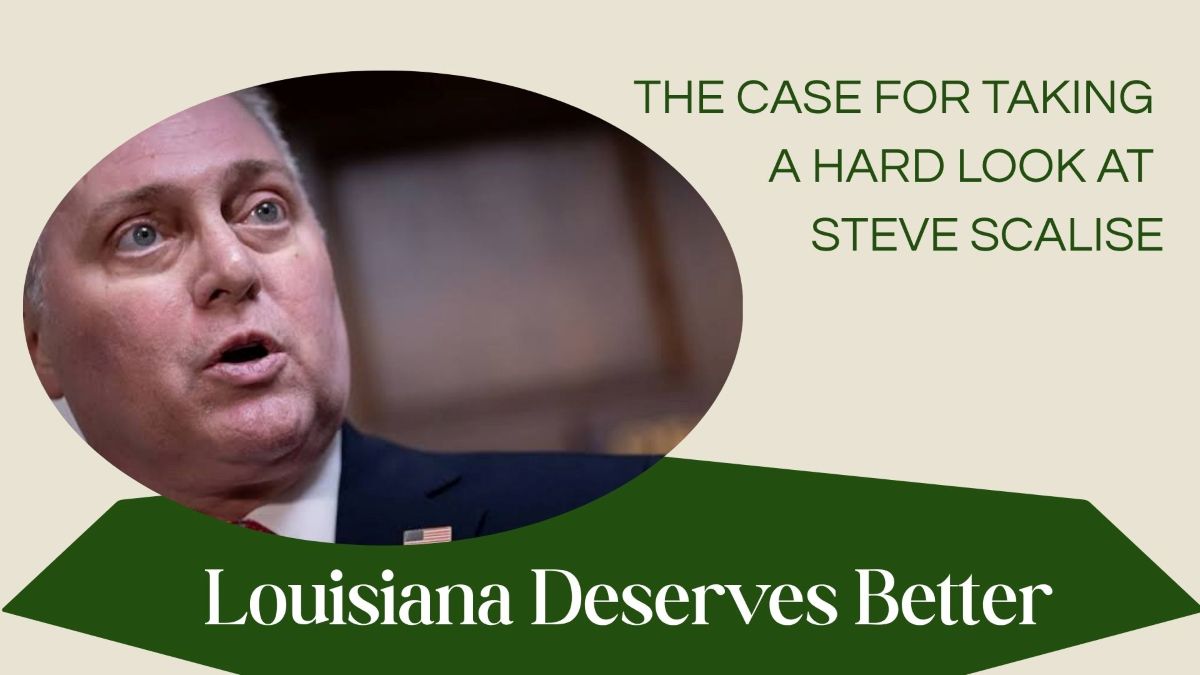
The Case for Taking a Hard Look at Steve Scalise
For nearly two decades, Steve Scalise has represented Louisiana 1st. District in Congress. He has risen from a relatively unknown state legislator to one of the most powerful Republicans in Washington, serving today as House Majority Leader.
That political longevity is precisely why his record deserves scrutiny.
The question Louisiana voters should be asking in 2026, is Steve Scalise delivering the kind of representation Louisiana and the country need.
The January 6 question cannot simply be forgotten
Perhaps the most consequential issue surrounding Scalise’s congressional record is his role in the January 6, 2021 effort to challenge the certification of the 2020 presidential election.
The official National Archives record shows that Joe Biden won 306 electoral votes to Donald Trump’s 232. (National Archives)
Yet Scalise voted in favor of an objection to Arizona’s electoral votes. The House rejected that objection by a vote of 303 to 121, with Scalise voting Yea. (Clerk of the House)
The Congressional Record also documents Scalise speaking in support of objections to electoral votes, arguing that states had failed to meet constitutional requirements. (Congress.gov)
That is a matter of congressional record, not opinion.
Whether voters consider those actions an unacceptable challenge to the peaceful transfer of presidential power is ultimately a question for voters. But it is entirely legitimate to ask whether a member of Congress who participated in those objections should continue to hold one of the most powerful leadership positions in the House.
A democracy depends not only on winning elections, but on accepting legitimate election results.
Nearly two decades in Washington
Scalise first entered Congress in 2008. He has now become part of the leadership of the national Republican Party. That experience is one of his greatest strengths. It can also be his greatest vulnerability. After this many years in Washington, voters are entitled to ask what the results have been for ordinary Louisiana families.
Louisiana continues to struggle with high insurance costs, flooding, coastal erosion, healthcare affordability and educational challenges.
Scalise can point to substantial federal projects and legislation benefiting Louisiana. His office, for example, has highlighted federal investments in flood protection, coastal restoration and projects throughout the state. That record should be acknowledged.
The question is: After nearly two decades in Congress and years in Republican leadership, are the results good enough?
Federal Money Is Not the Same as Results
Steve Scalise can point to substantial federal projects and legislation benefiting Louisiana. But federal dollars flowing into Louisiana do not end the debate.
If Louisiana has had so much federal investment and decades of powerful representation in Washington, why does the state continue to rank near the bottom on so many measures that directly affect people’s lives?
Louisiana ranked 50th in America’s Health Rankings, according to the 2025 annual report published in 2026.
The state’s poverty rate remains among the nation’s highest. America’s Health Rankings reports that 18.8% of Louisiana households were living below the federal poverty level, the highest rate among the states in that measure.
Louisiana also continues to struggle with economic opportunity, education, public safety and quality of life. One 2026 ranking placed Louisiana 50th in economic performance, 49th in education and health, and 40th in quality of life.
And yet Louisiana remains one of the nation’s most politically influential states in Washington.
That raises a bigger question than how much federal money has been announced:
What are Louisiana residents actually getting in return?
Federal projects can build roads, strengthen levees and improve infrastructure. Those investments matter. But they do not automatically translate into higher incomes, better health, stronger schools, safer communities or a better quality of life.
Louisiana’s problem is not simply a lack of federal dollars. The more difficult question is whether the state’s political leadership—Republican and Democratic, state and federal—has been successful in turning those investments into lasting improvements in the lives of ordinary Louisianans.
For voters evaluating Steve Scalise’s record, that is a legitimate measure of leadership: not simply how much money comes back to Louisiana, but whether Louisiana families are actually better off.
The Insurance Crisis
For Louisiana homeowners, insurance has become one of the most immediate financial problems they face. Premiums remain among the highest in the country, while hurricanes, flooding and coastal vulnerability continue to put enormous pressure on the insurance market.
Scalise can point to federal flood-control, coastal restoration and mitigation projects as part of his record. But those investments do not answer the question many Louisiana homeowners are asking:
Why are families still paying so much for insurance—and why does protecting a home remain so difficult and expensive?
Louisiana’s insurance crisis did not happen overnight. Hurricanes, repeated catastrophic losses, rising construction costs, reinsurance costs and insurers leaving or reducing their exposure have all contributed to the problem. The Louisiana Department of Insurance continues to describe the homeowners market as volatile, even as some insurers have begun filing rate decreases.
That leaves homeowners with a simple measure of whether government action is working: Are insurance bills becoming affordable again, and can Louisiana families actually keep the homes they worked to buy?
For Louisiana families, the insurance crisis goes far beyond homeowners insurance. Louisiana drivers are also facing some of the highest car insurance costs in the nation. One 2026 analysis using NAIC data ranks Louisiana as having the highest auto insurance burden in the country, with average premiums taking a larger share of household income than in any other state.
That means families can be hit from both sides—higher homeowners insurance and higher auto insurance—while wages and household budgets remain under pressure. Louisiana has received billions of dollars in federal infrastructure and disaster-related funding, but those investments do not automatically translate into lower insurance bills.
Healthcare and the 2025 Republican Agenda
Steve Scalise has been a longtime opponent of the Affordable Care Act and has supported Republican efforts to roll back major parts of the law.
In 2025, he also supported the One Big Beautiful Bill Act, which became law and included major changes to Medicaid and other healthcare programs.
The consequences are significant. The Congressional Budget Office estimated that the Medicaid provisions would increase the number of uninsured Americans by 7.8 million by 2034. CBO also found that the law’s changes to Medicaid and SNAP would reduce household resources by approximately $900 billion over 2026–2034.
Scalise and Republican leaders argue that their healthcare agenda will reduce costs, increase efficiency and make coverage more affordable. Scalise has continued to promote Republican proposals as efforts to lower healthcare costs.
But Louisiana has some of the nation’s poorest health outcomes, and many families already struggle with the cost of medical care and insurance.
That makes Scalise’s vote on the 2025 legislation an important part of his record.
The question for Louisiana voters is simple: If millions of Americans are projected to lose health coverage, how does that make healthcare more affordable for Louisiana families?
The Infrastructure Vote: Politics vs. Louisiana’s Interests
There is another concrete vote in Steve Scalise’s record that deserves attention: his vote against the Infrastructure Investment and Jobs Act of 2021, a major bipartisan infrastructure package that included funding for roads, bridges, ports, water systems, broadband and other infrastructure projects.
On November 5, 2021, the House passed the legislation, and Scalise voted Nay. The final House vote was 228–206, with Scalise among the Republicans voting against the measure. The political reality is difficult to ignore. The bill was a major legislative victory for President Joe Biden, and Republicans were to oppose Biden’s agenda. Scalise chose to vote against it.
For Louisiana, that raises a simple question: Did partisan politics become more important than supporting an infrastructure bill that could benefit his own state?
The One Big Beautiful Bill Act
Who Benefits From the “One Big Beautiful Bill”?
Steve Scalise voted YES on the One Big Beautiful Bill Act, the sweeping tax-and-spending legislation signed into law in July 2025.
The Congressional Budget Office estimates that the law will reduce federal revenues by approximately $4.5 trillion over 10 years, while reducing direct federal spending by about $1.1 trillion. The net result is an estimated $3.4 trillion increase in the federal budget deficit over the 2025–2034 period.
The question is not simply whether Americans received tax cuts. The more important question is who received the largest benefit and who bears the cost of the spending reductions?
The Tax Policy Center found that the tax provisions disproportionately benefit higher-income households. Households earning between $460,000 and $1.1 million—roughly the 95th to 99th percentiles—are estimated to receive an average tax cut of approximately $21,000 in 2026, increasing their after-tax income by about 4.4%.
By comparison, the tax benefit is substantially smaller for middle- and lower-income households. Earlier Tax Policy Center analysis found that roughly 60% of the tax benefits would go to the top 20% of households, while more than one-third would go to households earning $460,000 or more.
At the same time, the legislation reduces federal support for programs including Medicaid and SNAP. The Congressional Budget Office concluded that the effects are not evenly distributed: households toward the bottom of the income distribution generally see their resources decrease, while households in the middle and toward the top generally see their resources increase.
That creates a difficult question for working families. A tax cut can put more money into a household’s pocket, but if that same household—or a family member—depends on Medicaid, SNAP, or other assistance, reductions in those programs can offset or outweigh the benefit.
There is also the larger issue of the nation’s finances. The United States entered 2026 with federal debt already approaching $40 trillion, according to Treasury data, after ending fiscal year 2025 with approximately $37.64 trillion in total debt outstanding.
CBO estimates that the One Big Beautiful Bill will add approximately $3.4 trillion to the federal deficit over 10 years. That means the country faces a basic fiscal question: How should the government balance tax reductions, spending on programs serving lower-income Americans, and the growing cost of the national debt?
For Louisiana voters, that is part of the record to consider when evaluating Steve Scalise’s vote on the legislation. The numbers show that the law provides tax benefits across income groups, but the largest benefits are concentrated among higher-income households, while CBO projects that households near the bottom will generally experience reduced resources as spending changes take effect.
| Item | Estimated 10-year impact |
|---|---|
| Tax revenue lost | $4.5 trillion |
| SNAP federal spending reduction | About $287 billion |
| Medicaid reductions | Hundreds of billions |
| Additional uninsured by 2034 from Medicaid provisions | 7.8 million |
| Overall increase in federal deficit | $3.4 trillion |
CBO estimates the SNAP provisions alone reduce federal spending by $287 billion over 2025–2034, or about $309 billion including estimated economic feedback. For Medicaid, CBO estimates the provisions would increase the number of uninsured by 7.8 million people in 2034.
Steve Scalise, MAGA Politics and the Growing Divide in American Politics
Steve Scalise has become one of the most prominent Republican voices supporting the MAGA movement and the political agenda of Donald Trump. His public statements about Democrats and former President Joe Biden have frequently been sharply partisan, contributing to a political environment in which Americans increasingly view the opposing party not simply as a political opponent, but as a threat to the country.
Critics of Scalise argue that some of his attacks on Democrats and Biden have relied on misleading claims, selective presentations of information, or rhetoric designed to reinforce existing political divisions. That criticism is not without precedent. In 2020, Scalise shared a manipulated video involving political activist Ady Barkan and Joe Biden. The video was subsequently labeled manipulated media by Twitter, and Scalise removed it after Barkan demanded that it be taken down.
The larger issue is the effect of this style of politics on the public. When political leaders repeatedly portray the opposing party as dishonest, dangerous, or fundamentally hostile to American values, it can deepen distrust between citizens. Supporters may become more likely to accept claims from their own political side while dismissing information from opposing sources.
That dynamic extends beyond Steve Scalise. The United States has experienced a broader rise in partisan hostility, with politicians on both sides using increasingly aggressive rhetoric to motivate their supporters. Scalise’s role is significant because he is a senior Republican leader and a prominent Louisiana representative who has closely aligned himself with Trump and the MAGA movement.
For Louisiana voters, the question is therefore larger than party politics. It is worth examining not only how Scalise votes on legislation, but also how he communicates with the public, how accurately his claims stand up to independent fact-checking, and whether his political leadership helps reduce divisions or contributes to them.
Political disagreement is a normal part of American democracy. But disagreement based on demonstrably false or misleading information can make constructive debate much more difficult. Voters deserve political arguments that can be tested against evidence rather than claims that simply reinforce what one side already believes.
Climate change
This is potentially a significant ideological difference.
Scalise has historically been skeptical of the severity or certainty of human-caused climate change and has opposed many Democratic climate policies. His public comments have included saying temperatures naturally fluctuate rather than embracing the mainstream scientific framing of human-caused warming.
LGBTQ+ rights
This is one of the clearest ideological contrasts.
Scalise voted against the Respect for Marriage Act in 2022. The legislation passed the House 267–157, with 47 Republicans voting yes; Scalise was among the Republicans voting no. Scalise has consistently opposed federal legislation LGBTQ+ protections.
Steve Scalise voted against the Equality Act (H.R. 5) on February 25, 2021. The House passed the bill 224–206. The legislation would have expanded federal nondiscrimination protections to explicitly cover sexual orientation and gender identity.
Regardless of political party, the larger question is one of equality: Shouldn’t every American have the same opportunity to live, work, find housing and participate in society without being discriminated against because of who they are?
Money and political power
There is also a fundamental difference in the scale of the two campaigns.
Federal Election Commission records show Scalise’s campaign reported more than $10.6 million in receipts for the 2025–26 cycle through July 18, 2026, including more than $9 million in transfers from other authorized committees. (FEC.gov)
That money does not establish wrongdoing.
Nor does fundraising prove that a politician is corrupt.
But it illustrates something important about modern congressional politics: incumbency, leadership positions and national political networks create enormous advantages for politicians who have been in Washington for years.
The public should therefore distinguish between legal campaign fundraising, which is documented, and allegations of personal enrichment or corruption, which require separate evidence.
Enter Lauren Jewett
Lauren Jewett offers a dramatically different biography.
She is a Louisiana public-school educator who has spent 17 years working in special education classrooms. Her campaign emphasizes education, healthcare, insurance costs, working families and coastal protection.
That doesn’t automatically make her the better candidate.
Experience outside government can be an asset, but congressional representation requires knowledge of federal policy, legislation, negotiation and politics. Jewett would have to demonstrate that she could translate her experience as an educator into effective representation in Washington.
But that is precisely what an election is supposed to allow voters to evaluate.
The choice before Louisiana
The 2026 race presents a larger question than the personalities of two candidates.
It asks what voters expect from their representatives.
Should a congressman be judged primarily by his ability to rise through the ranks of his political party?
Or should he be judged by whether families can afford their homes, insure their property, obtain healthcare, educate their children and feel confident that their elected officials respect democratic institutions?
Scalise can point to real accomplishments, substantial seniority and enormous influence in Washington.
His critics can point to his vote challenging the 2020 election certification, his opposition to the Affordable Care Act, his infrastructure vote, his alignment with the Trump-era Republican agenda and the continuing problems facing Louisiana despite his years in office.
Both sides of that record deserve to be heard.
But one thing should not be controversial:
Louisiana voters deserve to examine the record for themselves.
And when they enter the voting booth, they—not Washington, not political parties, not campaign advertisements and not political commentators—should make the decision. That is what representative government is supposed to be about.
Steve Scalise conduct is beneath the dignity of the office he holds, he is always making false statements, so deceitful. It’s an insult to my intelligence. I am ashamed I ever voted for him.
we can’t send him back to Washington